Monday, August 22, 2011

Japanese Gov't to Rent Land Near Fukushima? Nuts!

There's some things going on about the Fukushima disaster that I just cannot understand. These problems all involve the government handling of the situation. I've written much about my dissatisfaction with that. 


The problem with the entire situation stems from government incompetence and the desire to be all things to all people in this crisis.


Yesterday, it came to fore that areas near the crippled Fukushima nuclear power plants will be declared uninhabitable for many ears to come. Does that come as a surprise to anyone? I wouldn't think so.


Now, it seems that the Japanese government is going to reimburse land and property owners near the Fukushima plant by paying them rent for all the coming years that they won't be able to live in their homes. I am completely against this notion and think this is just another government boondoogle that makes the rest of us pay for something that we had nothing to do with.


The New York Times reports:


TOKYO — Broad areas around the stricken Fukushima Daiichi nuclear plant could soon be declared uninhabitable, perhaps for decades, after a government survey found radioactive contamination that far exceeded safe levels, several major media outlets said Monday.

The formal announcement, expected from the government in coming days, would be the first official recognition that the March accident could force the long-term depopulation of communities near the plant, an eventuality that scientists and some officials have been warning about for months. Lawmakers said over the weekend — and major newspapers reported Monday — that Prime Minister Naoto Kan was planning to visit Fukushima Prefecture, where the plant is, as early as Saturday to break the news directly to residents. The affected communities are all within 12 miles of the plant, an area that was evacuated immediately after the accident.

Why is this a surprise? Didn't everyone expect this long ago? When the government announced a few weeks ago that they were planning to allow residents to return this year, didn't everyone think they were talking like the fools that they are?
The government is expected to tell many of these residents that they will not be permitted to return to their homes for an indefinite period. It will also begin drawing up plans for compensating them by, among other things, renting their now uninhabitable land. While it is unclear if the government would specify how long these living restrictions would remain in place, news reports indicated it could be decades. That has been the case for areas around the Chernobyl plant in Ukraine after its 1986 accident.

Like I said, under what twisted rules will the government determine the land value of these areas? Their current value must be zero, right? What is the difference between this and the US government buying all those billions of dollar of so-called "toxic-assets" from the failing uS banking system? There isn't any. It is just throwing public money down the toilet.
Since the Fukushima accident, evacuations have been a sensitive topic for the government, which has been criticized for being slow to admit the extent of the disaster and trying to limit the size of the areas affected, despite possible risks to public health. Until now, Tokyo had been saying it would lift the current evacuation orders for most areas around the plant early next year, when workers are expected to stabilize Fukushima Daiichi’s damaged nuclear reactors.

Ha! No one who has been paying any attention even thinks anything the government says is anything but a sick joke. Once again, they show their total incompetence and lack of common sense and delusion. Kan and his cronies keep hoping that things will get better but as a friend once told me, "Hope isn't a very good business plan." How in the world it is that Kan is still prime minister is astounding.
The government was apparently forced to alter its plans after the survey by the Ministry of Science and Education, released over the weekend, which showed even higher than expected radiation levels within the 12-mile evacuation zone around the plant. The most heavily contaminated spot was in the town of Okuma about two miles southwest of the plant, where someone living for a year would be exposed to 508.1 millisieverts of radiation — far above the level of 20 millesieverts per year that the government considers safe.
The survey found radiation above the safe level at three dozen spots up to 12 miles from the plant. That has called into question how many residents will actually be able to return to their homes even after the plant is stabilized.

The only good note that can be deemed from all of this is that, with everyone being so nervous and doing some serious checking and investigation, that no one has found any wide contamination in Tokyo is a good thing. Let's hope it stays that way and people remain vigilant.


Frankly speaking, in a nutshell, here's what I think:


1) The TEPCO nuclear power plant is a privately owned business. When they made profits, they kept them. When they lose money (as in the recent accident) I don't understand why the public has to bail them out. They make a profit, they pocket the money. They lose money and the public has to pay through increased taxation? Does that seem fair to you? It doesn't to me.


2) Once again, the government is easy to spread around public tax monies paid for by you and me.... After all, it's not their money.


3) This sounds really cold, but the people who lived around those nuclear power plants profited in their businesses and livelihoods for decades due to the business and economic benefits those nuclear power plants provided as a main source of jobs and revenue for the people living in the area. Why are they different than TEPCO? They profited for many years off of businesses and jobs created by the TEPCO plant. Now that there has been a terrible accident, why do the rest of us have to pay them rent for their houses that they can no longer live in?


4) Who will decide the amount of rent to be paid? Surely we will be paying way over current market value on those properties as their current value - since the disaster - must be close to zero.


5) Why are we, the public, being asked to pay for these properties? What is the purpose of private so-called "fire and marine" insurance? (Insurance for covering accidents and disasters befalling private property?) If the owners of property had no insurance, then that is their stupidity and loss. Why should the rest of us pay for that?  When, say, a property on a mountainside is burned down in a fire, are the rest of us expected to pay for that property owner's loss? No.


The disaster of March 11 is a tragedy for those who lost homes, family and livelihoods. These sorts of occurrences are why there is insurance. There is no good reason that the government has volunteered for the rest of us to pay for these people's losses. They profited from the good times, they must suffer for the bad. 


Paying these people, like paying TEPCO, is not fair. It is the same as the US government using tax monies to bail out the big banks when they were in trouble.


The rest of us didn't experience personal or financial gain from the good times, we should not be expected to pay for the bad.


I am against this sort of expenditure of public monies whether it is to be spent to help a private business like TEPCO or a private landowner like those who lived near the Fukushima reactors. People must have known the risk. They should have moved if they didn't like the chances. The rest of us should not be expected to pay for their poor judgement or bad luck.


That is what insurance is for.


As with all tragic events, I wish for good luck for those people and survivors of these disasters... But I can't see how you or I should be forced to pay for it.

Sunday, August 21, 2011

Little Things That Make Japan Best: Politeness and the Telephone

Japan will teach you patience. In everyday life, Japan has great lessons for westerners who come from nations full of people with the "Me! Me! Me!" entitlement attitude.
Many people find Japan's pace frustrating. But I think the wise people will find Japan's pace in showing them (and helping them with) patience is actually much better for their physical and mental health.


Think about it: the Japanese live, on average, about 8 years longer than Americans do. Of course diet has much to do with it. But people here rarely scream and shout. This sort of "flying off the handle" that (especially) Americans are guilty of cannot be good for one's health. Getting mad over insignificant things is just a cause of stress and can only harm the person doing the stressing.


As everyone knows, stress is a killer of relationships and life!


Actually, on a recent trip to the USA, besides the regular stress that I think is just "in the air" at the USA these days, I watched some TV... I felt like I was being yelled at all the time. What a stressful experience. Not good for my health. But, just a part of today's American society... Not good for anyone's health, I'm sure. But America's don't realize it anymore. It's part and parcel of that society nowadays.


But I digress...


Japan is world famous for politeness but nowhere in Japan does the politeness reach the plateau of Mt. Everest like it does when talking to strangers - or on a telephone call (excepting for when you might be talking with a geisha - so how often does that happen?)


I have seen and heard, with my own eyes and ears, Japanese people who were in arguments (thought they never scream and shout like Americans do) with friends and family. Then, suddenly, the telephone rings.


They made their last comments along the lines of, "Be quiet now! There's the telephone!" Immediately, all tensions and frustrations disappeared in a flash! It's like they were different person! They picked up the phone and answered in a most calm and sweet tone.:


"Moshi moshi! (Hello!) This is the such-and-such residence."


It is like being on another planet. One moment ago, they were in the midst of a heated discussion. Now, it seems they just stepped out of a peaceful field of grass and flowers. As my friend Kevin Riley observed, "...It's like they have a split personality." Ah! Fresh air!


It doesn't matter if the caller is a friend or business associate or even some salesman, the Japanese are very polite in their tone and mannerisms. Like a person stepping out of an extremely hot outdoors into the blast of a cooling air-conditioned breeze of a department store open doors, the Japanese will show courtesy to even strangers who intrude upon themselves - if even in a telephone call.  


As my friend, Andy in Japan, has recently related - though using a much heavier example than mine above (concerning the police), just another reason Japan is a much better place to live than the USA.  

IS ~Otoko demo Onna demo nai Sei~ eps 1-4


IS is one confusing dorama. I haven't been this confused since I found out Kayo Police was a dude. Anyway IS is a story about intersexuals, people who are born with both more and female traits like in the case of our main protagonist, Haru (Fukuda Saki) who was born with a vagina and an oversized clitoris/small dick. Haru was born with both ovaries and testicles but her testicles were removed when she was a child.


However Haru was raised as a boy and acts like a boy thanks to Fukuda Saki's acting which will prevent me from looking at her the same way again. To get into high school, Haru has to pretend to be a girl and he finds himself getting his period and dealing with all sorts of confusing questions.


IS starts of with a recap of the parents having Haru and them learning to deal with Haru being an intersexual. With the happy intro and perfect parents, it just looked like yet another Ichi Litre no Namida/Taiyo no Uta. I'm not saying IS is a disease but rather that it seemed to be following the formula of here is a rare condition, they're gonna have a perfect family and its going to be a bright melodrama with all the cliches.


IS finally got interesting for me when it was revealed that Miwako (Gouriki Ayame), Haru's friend is also an IS. Her male organs had been removed and she had been taking female hormones since young but her vagina is underdeveloped. Oh yeah, Gouriki Ayame is a picture of kawaiiness who needs to be put in a goth loli dress.  :)


I guess the whole point of IS is the journey of Haru, a person who's gender cannot be defined. It is an interesting topic but whether it will rise above the standard show and tell stories of Ichi Litre and Taiyo no Uta, I cannot say.

Saturday, August 20, 2011

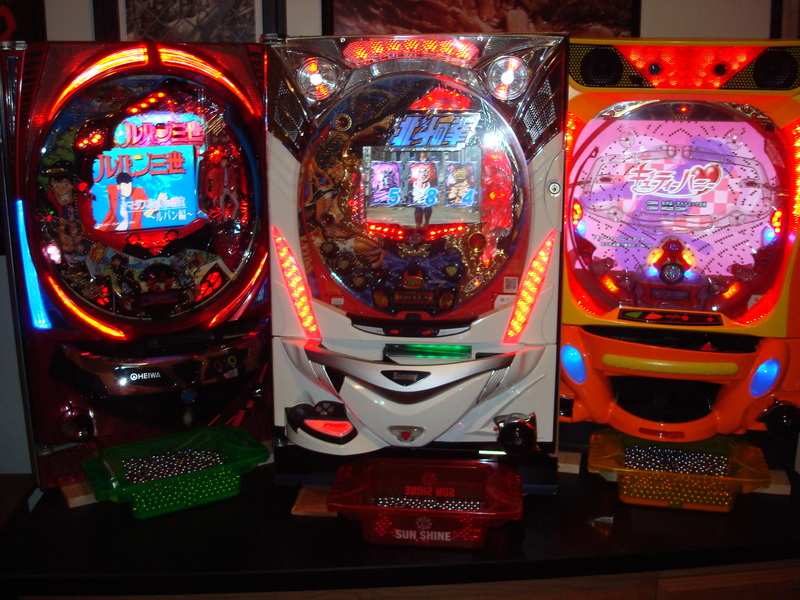
Nicholas Cage in Japanese Pachinko TV Commercial

Over the years, many famous actors and actresses from the west have appeared in Japanese TV commercials. It used to be that they could do these kinds of jobs, and take the money and run and their fans in the west wouldn't know about it.


James Colburn appeared in many cigarette commercials in Japan


But, now with the advent of the Internets, they can't get away with that anymore.


Now, they had better do commercials that, if someone back home does see them, they won't be too embarrassed nor will the commercials hurt their "coolness factor" nor their credibility.


Nicholas Cage did a bunch of those of those. He was in a series of commercials for pachinko (a kind of Japanese pinball gambling machine).


Enjoy!:


Friday, August 19, 2011

In Japan? Give the Gift that Shows You Have Taste and Style: 7-11 wine!

In Japan, as with most civilized countries, I think it is customary when visiting someone's house or accepting and invite for dinner, that you bring along a gift that shows you care. A gift that displays that special savoir fare of the distinctive class of gentleman (or gentlewoman) that you are. That is why, especially in Japan, when visiting or intruding on friends, one must never arrive without a present in hand.


Chateau de Marshall - The Marshall Family Summer Escape Palace


This weekend my family and I were invited to one of my ultra-rich friend's homes out on the beach overlooking a beautiful ocean view. The house is fabulous and the view breath-taking.


We awoke at 3:45 in the morning to begin the 3 + hour drive down to Shimoda from Tokyo to visit my friend's holiday retreat palace.


Shimoda is a famous ocean and beach resort town and is well known for being the city that Commodore Perry and the famous Black Ships visited in 1853 when forcing Japan's doors open to the world.  It is a special place rich in tradition and history.


Since we woke up so early to drive down to Shimoda, I was pretty drowsy and not thinking straight as I had worked until 11:30 the night before and only gotten in about 3 hours of sleep. I would soon come to regret that.


Nevertheless, without a care in the world, we all hopped in the car and began the long trek to our last dream vacation of the summer of 2011.


Along the way, we stopped at many convenience stores to visit the rest rooms and relieve ourselves... At one of the final stops, a 7-11 just on the outskirts of Shimoda, I realized that I had made a gross fox pass (or is it foie gras?)... I had committed a gross error equal to the level of participating an orgy of evil: I had forgotten to buy a classy present to bring to our hosts.


Quickly I scanned the 7-11 shelves for the best wine they had! Wow! Oh, thank heaven for 7-11 (いい気分〜ん)I was in luck. They had the good quality stuff!

Note the 7-11 label. The sign of distinction!

It was tough to choose from the fine selection of fine wines they had available. The Yosemite Road looked quite appealing and, at only ¥598 yen a bottle (about $7.81 USD) for quality Cabernet Sauvignon, who could go wrong?

But my friends are worth a bit more than that to me! So I splurged and bought the 7-11 Bourdeaux (Bor-dorks for you American readers) at ¥798 a bottle (about $10.28 USD). It is a fine wine and tasteful vintage... And, not only that, the wine comes in an easy to open screw top bottle. No messy corks to deal with. Isn't that "special" convenient? 

After all, my friends are worth that much to me! 

Thank God for 7-11 for saving my a*s for forgetting to buy a present for my friends. I mean, after all, if I am going to visit my millionaire friend's summer vacation home and be a guest, I'd better bring a killer bottle of wine with me! 

Upon paying for the wine, my wife appeared from the restroom and asked me what I was doing. I showed her the wine. 

She gasped, "You're not going to give that cheap wine to your friends are you?"

I hid the bottle behind my back... "Er, of course not, honey... I , er, was thinking that we needed to buy a present... "

"I already took care of that!" She replied. 

Like the good Japanese wife she is, yesterday she went to the ritzy department store and bought a bunch of very expensive sweets for our hosts.

When she gave the cookies to the hosts, they seemed really happy to receive them.

Of course they did. These people are refined and have good taste. 

I wouldn't be seen in public with them drinking that dredge that 7-11 calls wine..... Yuck! (I'll just drink it by myself at home - after all it's probably a heck of a lot better than the ¥218 a bottle one cup Takara Shochu rot-gut that I usually drink !)

Ah! The good life... Every once in a while, it's nice to see how folks live on "the other side".

Thanks to Roger and Miki Marshall     

Thursday, August 18, 2011

In Japan, One Box of "Magic" Cookies and an Apology is Worth Millions!

In Japan, when someone makes a mistake at your company, and you are the boss, you can never berate that employee in public nor can you, as boss, tell the offended client or customer that your employees is to blame. You can never blame the mistakes on your staff. You have to take the blame.


No matter what happens, as captain of the ship, you must be the responsible person for whatever goes on. It can be a thankless job too. If things go well, you must give credit to your staff. If things go bad, you must take all the blame.

THE JAPANESE TRADITION: APOLOGIZING
Sometimes, even the Japanese laugh at these traditions....
(well, older folks don't... No sense of humor!)

That is the honorable and smart was way to do business in Japan.


Last week, my company royally screwed up a campaign for a client. That client had over 300 complaints from customers in less than a few hours! The error was 100% the fault of my company and it was an embarrassingly foolish mistake; we had incorrectly written bank information for money transfers on an online document. This made a situation whereby hundreds of people couldn't transfer the money to the appropriate account in order to received the goods they wanted.


As I said, over 300 people had complained to our client and the client was, understandably, furious at us. I was furious at my staff for making such an amateurish mistake but I couldn't say that to the client. Nor did I berate my staff openly.


First we calmly rectified the account information. That night I called the people in charge at the client company and apologized. They were noticeably upset. This client is my companies #1 most important customer. Their account is worth tens of millions of yen to us. But because of this mistake, we were in danger of losing that account forever.


And all because of a careless Jr. high school level mistake.


I knew what I had to do.... I had to buy a box of cookies.... Not just any cookies. "Magic" cookies. The good stuff.


Yes. That's right. A box of quality cookies, a sincere apology, accepting complete responsibility along with bowing profusely to the in-charge at the client company.... Just might make things all right.


It certainly couldn't hurt and is worth the risk in order to save the contract.


In Japan, no matter what happens, the Japanese like it if you take complete responsibility and humbly apologize for your errors. Being able to say "I'm sorry" and saying it like a man and not someone who wishes to blame someone else, will make the Japanese respect you as a person and a businessman much more.


I went to a ritzy department store and bought the best box of cookies they had. The box cost ¥5,600 (about $73!) pretty expensive for  a dozen cookies! I went to the client company with the cookies. I knew that the in-charge showed up for work around 1 ~ 3 pm everyday. 


But he doesn't know that I know that.


I showed up at his office at 11:00 and let the receptionist know I was there.


She said, "Do you have an appointment?"


"No." I replied, "But my company made a serious mistake last night and I must apologize so I came here. I will wait until he arrives. Please tell him that I am waiting." Of course, I asked the receptionist what time it was so that she would make a mental note of it.


Then, I sat in the lobby and waited. Well, actually, I did work on my laptop. Work I would have done had I been at my office. But here, I could do the work and show diligence in making sure that I met with the in-charge.


I waited and the girl asked me a couple of times if I still wanted to wait. "Of course," I replied.


Finally, at 2:30 pm, the in-charge showed up. He was so surprised to see me.


He said, "You've been sitting here for a few hours!?"


"Yes. I needed to see you and apologize." I replied.


We sat and talked and I explained everything all the while taking full responsibility. I bowed over and over and handed over the box of "Magic" cookies and asked that he share it with his staff who we had bothered with our stupid mistake.


After thirty or so minutes of talking he became much calmer and actually smiled. I told him that they were the #1 most important client to us and that we would do anything to make it all right - even forfeit all of our commissions for this one event. He thanked me and asked that we be more careful next time and he promised me that, on his side too, they'd try to be more organized so that things weren't done so rush-rush and last minute.


I thanked him and we shook hands. The contract was saved and we won't be penalized for the error. We just must be more careful next time.


With this 3.5 hour effort of waiting and a $73 dollar box of cookies I saved a multi-million yen contract.  I also saved us from losing all commissions from this particular event. This one event was worth about $60,000 to us. I saved it with a short wait, a bunch of humility, a lot of bowing and taking responsibility... 


...And a $70 box of cookies.


Now, if those cookies aren't magic, I don't know what is.  

THE JAPANESE TRADITION: DOGEZA

Freeter, Ie wo Kau eps 5-10


Freeter is a dorama with an identity crisis. It wants to be this character study, serious movie type story life as a temporary employee and dealing with an assortment of family problems including a mother battling depression. On the other hand, it is shot like your typical brightly lit prime time dorama with your usual jdorama cliches to help pad it out.


Yup, I'm still hung up over the lighting that makes it look like a daytime soap opera because Freeter has some interesting things to say about working life and depression. About how choosing who you work with can be more important than choosing where you work. About what the big deal is about being a temp worker rather than a permanent one.


Sure, there is no job security but what job has? The only major difference would be long service leave. Lots of I.T. jobs now are contract based. I kind of enjoyed watching Seiji gaining his confidence in himself one step at a time and his dysfunctional relationship with his father is fun to watch.


On the other hand, we have Karina's soap opera story which just feels like fluff especially the 'woe is me cause two accidents happened on my watch' self pity. Talk about trying to squeeze blood from a stone. If you followed all safety procedures or if someone was bloody reckless, then its not your fucking fault! Instead of calling out Karina's character for the idiot that she is, everyone just stands back and just says 'poor girl'.


Then we have Igawa Haruka's story where she plays this wife with mother in law trouble to an absent husband. I can see why they chose not have to the husband on screen but it does not validate her relationship with her rich husband. Sure, in the end she learns to stand up to her mother in law in the end but there is nothing to cheer for. There is no background story. It is a mere conflict because she had for a long time chosen to accept the mother in law's abuse. In the end when the husband supports her, it is not big deal cause we don't know who he is. He has been a character that existed by name throughout the series.


The less said about the OL relationship with the persistent guy the better. I enjoyed Asano Atsuko's portrayal as Seiji's mom. Maybe its because her face doesn't look as plastic as it was in Maria or maybe her relationship with Seiji's short tempered dad felt real. In summary, Freeter has a good main story and is brought down by cliched side soap opera stories. Its watchable but prepare for some scenes and storyline that would make you cringe. Perhaps I am concerned to much with what Freeter could be and not what it is, fluff with hints of substance.
Related Posts Plugin for WordPress, Blogger...